- Home
- Blog
- Middle Tennessee Clay Soil: Why Drainage and Grading Must Be Done Together
Middle Tennessee Clay Soil: Why Drainage and Grading Must Be Done Together
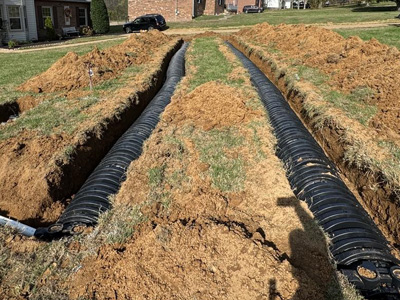 If you live in Middle Tennessee, you already know the soil is different here. From Mount Juliet to Lebanon and throughout Wilson County, dense red clay dominates residential and commercial properties. While clay soil can provide a stable base when properly compacted, it also creates serious water management challenges. That's why drainage and grading must always be designed and installed together - not as separate afterthoughts.
Understanding how clay behaves is the first step in protecting your home, foundation, and landscape investment.
Understanding Middle Tennessee Clay Soil
Clay soil in this region is tightly compacted and composed of extremely fine particles. Unlike sandy or loamy soils that allow water to filter through easily, clay absorbs water slowly and drains poorly. Once saturated, it holds moisture for extended periods.
This leads to several common problems:
- Standing water after heavy rain
- Soft, unstable ground conditions
- Foundation pressure and settlement risks
- Yard erosion and washouts
- Basement or crawl space moisture intrusion
Clay soil also expands when wet and contracts when dry. This constant expansion and shrinkage cycle can shift foundations, crack driveways, and create uneven ground surfaces if grading and drainage aren't properly managed.
Why Grading Alone Is Not Enough
Grading shapes the land to create slope and direct water away from structures. It is a critical first step in site preparation and foundation protection. However, in clay-heavy soil, grading by itself does not solve drainage problems.
Even if the surface slopes properly, clay slows down water absorption. During heavy storms - which are common in Middle Tennessee - water can accumulate faster than it disperses. Without a drainage system to move water efficiently, runoff may still pool near foundations or low spots.
Improper grading can also make things worse. If slopes are too aggressive, water can erode soil quickly. If slopes are too subtle, water may stagnate. Precision grading is essential, especially in areas with subtle elevation changes.
Why Drainage Alone Is Not Enough
On the other hand, installing drainage systems without proper grading is equally ineffective. French drains, channel drains, or catch basins can only collect water that flows toward them. If the yard isn't shaped correctly, water may never reach the drainage components.
For example:
- A poorly graded yard can trap water in a bowl effect.
- Downspouts may discharge into flat areas without runoff direction.
- Swales may fail if surrounding grades push water the wrong way.
Drainage systems depend on gravity. Without proper grading to guide water, even the best drainage installation will struggle to perform long-term.
The Risk to Foundations and Structures
In areas like Mount Juliet and surrounding communities, many homes are built on crawl spaces or slab foundations. Clay soil saturation creates hydrostatic pressure - the force of water pushing against foundation walls.
When grading and drainage are not coordinated:
- Water collects along foundation edges
- Soil expands against concrete walls
- Cracks can form in foundations or masonry
- Moisture can enter crawl spaces
Over time, this can lead to costly structural repairs. Proper site preparation during construction - or corrective grading and drainage retrofits - can significantly reduce these risks.
How Drainage and Grading Work Together
A comprehensive approach combines surface grading with subsurface drainage solutions. When done correctly, the system works as one integrated design.
Establishing Proper Slope
The first step is reshaping the land to create positive drainage. This means ensuring soil slopes away from foundations at the proper percentage. Even small elevation adjustments can dramatically improve runoff direction.
Managing Roof Runoff
Downspouts should discharge away from the home and tie into drainage systems when necessary. In clay soil, simply allowing water to spill near the foundation can create persistent saturation zones.
Installing Strategic Drainage Systems
Depending on the property, solutions may include:
- French drains to intercept subsurface water
- Surface drains in low areas
- Swales to redirect runoff
- Catch basins connected to discharge lines
These systems must be positioned based on how grading directs water.
Compaction and Soil Stabilization
Proper compaction is essential in clay environments. Poorly compacted soil settles unevenly, creating new low spots where water can collect. Experienced excavation and grading professionals understand how to balance compaction with drainage flow.
Erosion Control in Middle Tennessee
Heavy seasonal storms can move large amounts of water across properties in short periods. When grading is too steep or drainage is poorly managed, erosion quickly becomes a problem.
Clay soil may appear firm when dry, but when saturated, it can wash away or rut under water flow. Integrated grading and drainage reduce velocity, manage runoff paths, and protect the integrity of the soil surface.
When to Address Drainage and Grading
You may need a combined solution if you notice:
- Water pooling in your yard after rain
- Muddy areas that never fully dry
- Cracks in your driveway or foundation
- Soggy crawl spaces
- Erosion along property lines
Addressing these issues early prevents more extensive repairs later.
The Importance of Professional Site Evaluation
Every property in Middle Tennessee is different. Elevation, soil compaction history, nearby structures, and neighboring drainage patterns all affect performance. A professional evaluation considers the entire site - not just isolated symptoms.
At Gibbs Excavating & Grading, comprehensive site prep services are designed with clay soil conditions in mind. By analyzing slope, runoff patterns, and subsurface behavior, drainage and grading are engineered to function together as a complete system.
Protecting Your Investment Long-Term
In Middle Tennessee's clay-heavy environment, treating grading and drainage as separate projects can lead to recurring problems. When integrated properly, they protect foundations, preserve landscaping, prevent erosion, and extend the life of outdoor improvements.
If you're building new, renovating your yard, or correcting existing water issues, addressing both grading and drainage at the same time is not optional - it's essential.
A well-designed site is more than just level ground. It's a strategic system built to handle water the right way, from the first rainfall to the heaviest seasonal storm.
Schedule a Drainage & Grading Evaluation for Your Property
If you're dealing with standing water, erosion, or foundation concerns on your Middle Tennessee property, don't treat drainage and grading as separate fixes. A properly engineered solution addresses both - protecting your home, improving runoff control, and preventing long-term structural damage.
At Gibbs Excavating & Grading, we specialize in site prep solutions built specifically for clay-heavy soil conditions in Mount Juliet and surrounding areas. Our team evaluates your entire property to design a grading and drainage plan that works together as one complete system.
Contact us today on 615-419-245 or via this Online Form, and we will respond soon.